 |
| Sunrise, Ubehebe Crater |
Showing posts with label landscapes. Show all posts
Showing posts with label landscapes. Show all posts
Tuesday, October 11, 2016
Photographying Death Valley

Saturday, June 25, 2016
From the Landscape Archives
I was recently "nominated" or challenged—I'm not sure which is more appropriate—to post on Facebook one photo a day of something having to do with nature. So I decided to drag out some old faves that I hadn't seen in awhile, and more to the point, my Facebook had never seen. If nothing else, I was able to prove to myself that I had taken in my lifetime at least seven decent pictures. And here they are:
 |
| Cedar, Hoh River Rain Forest, Olympic National Park |
 |
| Dusy Basin, Sierra Mountains |
 |
| Garrapita State Park, California |
 |
| Lake Shikotsu, Hokkaido, Japan |
 |
| Kruger National Park, South Africa |
 |
| Desolation Wilderness, Sierra Mountains |
 |
| Tehachapi Mountains and Central Valley, California |
Tuesday, June 24, 2014
Pine Creek Canyon
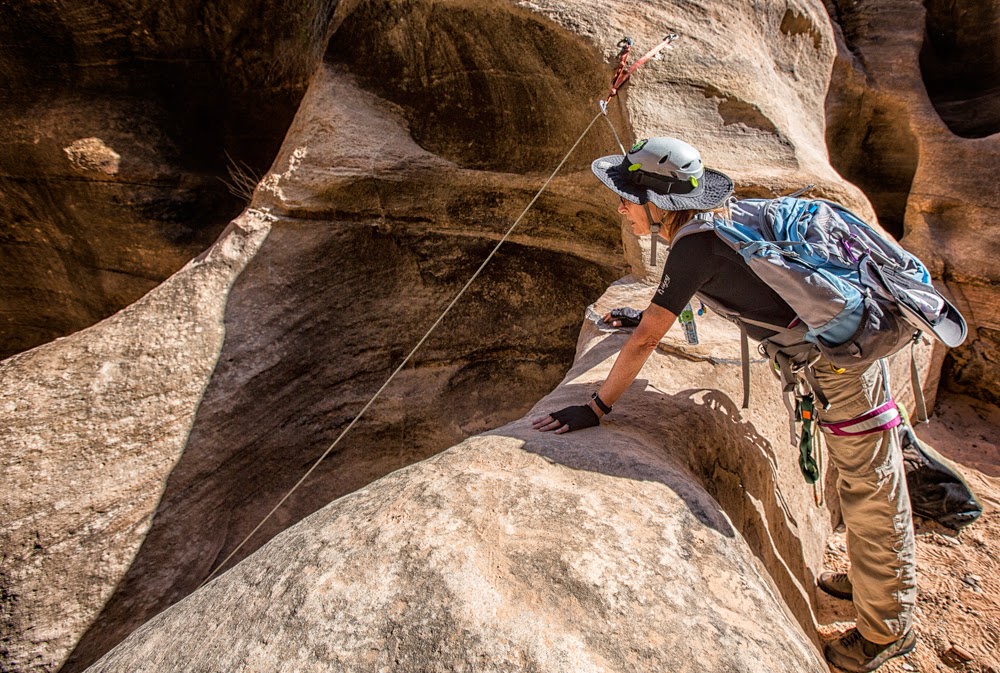
I've talked before about the difficulties of photographing a canyoneering trip. But every once in awhile, our merry band comes across a canyon that has all the right angles and light for wonderful pictures. I think Pine Creek Canyon in Zion National Park qualifies. My two biggest complaints is lack of good angles to shoot (rappels are often in constricted spaces where it's nearly impossible to shoot anywhere but up or down) and the sometimes necessary speed we have to take on in order to get through a canyon before the end of the day. Pine Creek Canyon? Negative on both accounts. It was a real pleasure to have great angles and a leisurely pace (well, sort of; we planned on doing another, shorter canyon the same day). I had the time to ask my buds to wait for me when a photo op appeared, and there were plenty of those. Pine Creek Canyon is full of wilderness eye candy.
But the bottom line for me is how many good photographs I was able to squeeze out of the canyon. That doesn't happen often. I was happy throughout. What a pleasure.
On a technical note, I went with just one lens, my 16-35mm, and there were many places where there was bright and dark spots in the same shot, so I did a lot of HDR, five-exposure brackets. Many of the pictures in this portfolio come under that category. If I did my job right, it's not obvious. Lastly, lots of darkness where I was shooting anywhere from ISO 400 all the way to 26,400. Love that Canon 5D MIII with its low-light performance!
But the bottom line for me is how many good photographs I was able to squeeze out of the canyon. That doesn't happen often. I was happy throughout. What a pleasure.
On a technical note, I went with just one lens, my 16-35mm, and there were many places where there was bright and dark spots in the same shot, so I did a lot of HDR, five-exposure brackets. Many of the pictures in this portfolio come under that category. If I did my job right, it's not obvious. Lastly, lots of darkness where I was shooting anywhere from ISO 400 all the way to 26,400. Love that Canon 5D MIII with its low-light performance!
 |
| Jerri at the beginning approach to the top of the canyon. |
 |
| Rich descending the first rappel. |
 |
| Jerri watching Rich go down into the canyon. |
 |
| Jerri on first rappel while Kevin looks on. |
 |
| Rich descending into one of the most amazing canyon chambers I've seen. |
 |
| Jerri wading through chest-high water to the chamber's exit. Oh, yeah, that water was cold. |
 |
| A corridor through the canyon. |
 |
| Annette under a rare swatch of sunlight. |
 |
| The canyon version of driftwood. |
 |
| Another corridor. Note the chock stone overhead. |
 |
| Annette takes a brief snooze while Rich rigs the anchor. |
 |
| Out in the open again, Rich descends into one of the more spectacular scenes. |
 |
| Another canyon scene. Note in the upper left a "window" where the Zion tunnel cuts through the mountain. |
 |
| Sometimes you get lucky: Rich wore a bright yellow shirt that kept him from getting lost in the composition. |
 |
| Jerri belaying Annette. |
 |
| Yours truly descending a free rappel (photo by Jerri Lauridsen). |
 |
| Rich belaying Annette. |
 |
| A small pool near the last rappel. |
 |
| Rich washing off his gear of all the sand in a soothing, down-canyon pool. Caribiners get cranky when they're loaded full of sand and then they get stuck at the worst possible moments. |
 |
| Relaxing in the pool before what turned out to be a longer than expected (and hotter) hike out to the car. |
Tuesday, April 15, 2014
A Night at the Trona Pinnacles
 |
| The lunar eclipse between 11 p.m. and 1:30 a.m. |
Somehow, I've never photographed a lunar eclipse. I've seen bits and pieces of them over the years, but I didn't make the effort to record the experience. So when I learned a total eclipse was coming up for last night, I decided I had to finally push my ass into a car, drive out to the Trona Pinnacles and see what I could do to contribute to the thousands (millions?) of chronicles of the event.
I came semi-prepared with data that the wonderful photographer, Michael Frye, had put on the Internet for anyone who wanted shoot the moon, so to speak. When I got there, I first thought I wanted to compose an image with the moon coming at me with one of the pointier pinnacles in the foreground. I began to suspect it wouldn't work, but I waited for the moon to show me its intended path and I could then always revise if necessary.
And then an SUV drove up. A man got out and breezily greeted me. "Here for the lunar eclipse?" I asked. Yes, he said, and walked up to me. It was the man himself, Michael Frye. He introduced me to his wife, Claudia, and we talked for a bit. While I expressed my appreciation for his work, Frye held up an iPhone with an app that showed the moon's path across the sky. (The app I had wasn't quite as explicit, plus I didn't have cell phone reception there.)
 |
| The rising moon three hours before the eclipse. |
Based on the information from his app, I moved the camera to another location. Frye decided to look for another spot. He had never been to the Pinnacles before and he apparently wanted to scout around before settling on a shot. Before the eclipse began, I changed my position two more times and finally got the combination of foreground and moon path that seemed good to me.
The picture I came up with is a blending of many exposures. The foreground was shot before the eclipse and illuminated both by moonlight and a flashlight painted over the pinnacle on the left. The eclipse sequence was done by photographing the moon every ten minutes (I first intended on doing it every 20 minutes, but after a couple of tests, the separation between each picture of the moon impressed me as being too much). The final picture was combined in Photoshop after adjustments in Lightroom. I'm now hooked and have ideas for the next eclipse which is coming up this October.
Monday, March 31, 2014
Contest Winner
I just learned that Backpacker Magazine chose the picture below as the winner in their "Adventure Travel" photo contest.
I have mixed feelings about this shot. Above all else, I'm proud of it and really like the contrasts between the pillowy snow above, the chunky rock, and the silky water. But behind all that is tragedy. The story: I was hiking the Pacific Crest Trail with my wife, Gloria, and a friend who had come down to California from Tacoma. On the second day of a five-day trip, we were walking through the Desolation Wilderness (west of Lake Tahoe), swatting mosquitoes and feeling a little broken down, not quite trail hardened. And then we saw this cave where the creek had carved a tunnel through a snowbank. I suppose it's fortunate that I was going old school that trip and brought my Mamiya 7II medium format camera loaded with Kodak Portra film. Nothing else would have preserved the huge dynamic range of the scene quite like print film. So I plunged into the cave with a tripod and 43mm lens on the camera and worked the scene, shooting low angles, high angles, looking down one direction, down the other. Had a hard time protecting the camera from dripping water and I was always conscious of how slippery the rocks were. I took this shot as I was exiting the cave and turned around for one last look. The exposure time was about five seconds. I knew this was probably the best of the best and in a stupor of self-satisfaction I stepped outside the cave and promptly lost my footing on a wet rock. I dove into the creek which was deeper than it looked and could feel my body being swept downstream. I managed to jab the tripod into the creek bottom and stand up. The first thing I looked at was the camera. The lens had smashed on a rock and the body was soaked to the point of being inoperable. And then I looked up to see a group of hikers staring down at me flabbergasted as if they couldn't figure out whether to help me out of the water or laugh. They did neither.
I had to go the rest of the trip without taking pictures and I was miserable.
But at least I got this picture . . .

I have mixed feelings about this shot. Above all else, I'm proud of it and really like the contrasts between the pillowy snow above, the chunky rock, and the silky water. But behind all that is tragedy. The story: I was hiking the Pacific Crest Trail with my wife, Gloria, and a friend who had come down to California from Tacoma. On the second day of a five-day trip, we were walking through the Desolation Wilderness (west of Lake Tahoe), swatting mosquitoes and feeling a little broken down, not quite trail hardened. And then we saw this cave where the creek had carved a tunnel through a snowbank. I suppose it's fortunate that I was going old school that trip and brought my Mamiya 7II medium format camera loaded with Kodak Portra film. Nothing else would have preserved the huge dynamic range of the scene quite like print film. So I plunged into the cave with a tripod and 43mm lens on the camera and worked the scene, shooting low angles, high angles, looking down one direction, down the other. Had a hard time protecting the camera from dripping water and I was always conscious of how slippery the rocks were. I took this shot as I was exiting the cave and turned around for one last look. The exposure time was about five seconds. I knew this was probably the best of the best and in a stupor of self-satisfaction I stepped outside the cave and promptly lost my footing on a wet rock. I dove into the creek which was deeper than it looked and could feel my body being swept downstream. I managed to jab the tripod into the creek bottom and stand up. The first thing I looked at was the camera. The lens had smashed on a rock and the body was soaked to the point of being inoperable. And then I looked up to see a group of hikers staring down at me flabbergasted as if they couldn't figure out whether to help me out of the water or laugh. They did neither.
I had to go the rest of the trip without taking pictures and I was miserable.
But at least I got this picture . . .
Thursday, February 20, 2014
Revisiting Old Photos
There's an interesting contradiction about photography. On one hand, making a picture can be a once-in-a-nanosecond opportunity where the action or the light is so ephemeral, if you miss it, it's gone forever. (Of course, there's something to be said for having memories that exist no where but in your brain, full of emotions and movements that no camera can duplicate.) On the other hand, once you've nailed that shot, you can reinterpret it over and over, changing the artistic emphasis with everything from color balance (including going to shades of gray) to lightening some elements and darkening others to cropping to even changing the sharpness. And let's not forget the manipulations that involve cloning out unwanted distractions or combining exposures to compensate for extreme contrasts in the scene.
And there's certainly nothing wrong with going back to a photo when I realize it can be done differently, perhaps better. Sometimes this is because my artistic vision has evolved or maybe it's just because the processing software has improved to the point where I can accomplish a look that wasn't technically possible before.
For years, I went out to various wild locations to photograph moonlit landscapes. I published several how-to magazine articles for people who wanted to try it themselves and a couple of travel pieces for those who just preferred to experience the calming, occasionally introspective nature of sitting under a full moon without worrying about camera gear.
The other day, I came across some scans of this old work, shot on a Bronica SQ-A medium format camera and transparency film. At the time of the first prints I made, I was somewhat pure about the final product, finishing the picture so that it looked like the original film version. With a 20-minute exposure, I was usually able to get a picture that looked vaguely like a daylight scene but not quite (star paths don't appear in the sky at two in the afternoon.) This worked for me at the time because the pictures had a weird sense of place that was partly literal and partly mysterious. But now I'm not so sure I like that interpretation and I redid some of the pictures. I like them better with a definitive look of nighttime.
What I did was import the tif files into Lightroom, increased the blacks and clarity, decreased the highlights and added a light vignette. Much better! (Of course, five years from now, I might change my mind and do something else.)
 |
| "Devastation Trail, 8:45 p.m." The difference is from the original isn't huge but to my eyes it looks more like how it felt to stand there at night. |
 |
| "Near Hidden Valley, 10:15 p.m." I wanted to emphasize the lit rock juxtaposed against the bright star path so I darkened the exposure, added black and a heavy vignette. |
Subscribe to:
Posts (Atom)