Wednesday, January 14, 2015

Helios Canyon

Three years ago, I learned that rappelling in the dark by headlight wasn't as scary as I thought it might be. I would recommend avoiding it whenever possible, but it's not so bad. Oh, sure, there's the part about looking over the edge at the top of a tall rappel and seeing only a black abyss below with no way of knowing if your rope hit the bottom. And certainly, the down-climbs are a little more exciting when the light from your headlight distorts how you evaluate handholds and footholds. And lastly, you see nothing of the canyon you came to explore except the rocks below your feet. But scary? Okay, it's a little scary, too.

The canyon I first discovered all this was Helios in Death Valley National Park. We had a little trouble finding the right approach, a steep mile long climb of some 1,100 feet elevation gain that took much longer than we expected. And by the time we hit the final two rappels, it was dark.

We returned to Helios Canyon with better insight for the approach and a determination to see what we missed by canyoneering at night. What we found was a nice little canyon.


This nondescript crack in the mountainside is the bottom portion of Helios Canyon.
Rich orienting us to the right spot with snow-capped Telescope Peak in the background.

The beginning of the climb made more thrilling by all the loose rock.

Rich and Annette working their way through a steep, slightly exposed traverse.

A pano taken near the top of the climb before we descended into the canyon which is to the right.
Yours truly climbing up the approach with the alluvial fan below. (photo by Rich Schmitt)

Rich took a spill over the sharp rocks. What would a canyon trip be without a little spilled blood?

Kevin about to go down the first rappel, a 60-footer with Rich backing up the cairn anchor.
Jerri going down the first rappel surrounded by lots of air and canyon walls.

A rare picture of me rappelling. (photo by Rich Schmitt)


Sunday, January 11, 2015

A Different Way to View a Rappel

Spent the weekend in two of Death Valley's many canyons. Our second adventure of the trip was Inconceivable Canyon which was in an area where all the canyons were named after something in the movie Princess Bride. Clever. ("It's inconceivable!" was a line from the film.) Here's a different approach to photographing someone on a rappel. This particular one was the longest of the canyon, 280 feet. I set up a tripod (yes, fool that I am, I lugged a tripod through the canyon) and shot a sequence of both Jerri and Kevin rappelling down the second half of the run, and then I combined them all in Photoshop.


Wednesday, December 10, 2014

Rubio Canyon

Rubio Canyon is the first canyon I ever descended using ropes. The canyoneering class I took conducted its instruction there, and it was a somewhat sadistic choice. The first rappel is about 85 feet or so down a roaring waterfall that is known amongst canyoneers for the rock surface being slick as oil. You have to really want to learn how to rappel in order get down. I did, sort of. I was rewarded with banged-up knees and my first indication that hiking boots wouldn't cut it for canyoneering in wet places. 

Now Rubio is a comfortable place for me. A canyon to practice on and keep sharp for the really extreme stuff we now do (funny, it seemed pretty extreme to me when I first did it).

So I decided to use the canyon to try out fixing a major complaint I have about photographing canyoneering and that is getting a feeling of action in the pictures. Even people on a rope start to look a little static to me now. So I went with an old trick, using slow shutter speed for blur and flash which freezes any action it touches. What I got isn't perfect, but it's a start.

I locked off on the first waterfall, named Thalehaha, and looked down as I waited for someone to go down the rope.


Annette is actually ascending the rope to fix a stuck rope.


Tuesday, December 9, 2014

Helios Canyon

A friend asked me to post pictures of Helios Canyon in Death Valley which we went through about two years ago. Always happy to relive the glory.


Tuesday, December 2, 2014

Death Valley canyons

I have to admit that the thrill junkie in me absolutely loves the technical canyons in Death Valley National Park. That is, the canyons (as previously posted on this blog) that often involve arduous approaches, high, long rappels and nearly impossible down-climbs. But nearly as spectacular as those rugged canyons are the ones that are much, much easier to get in and out of. Here are three that I recently visited, Marble, Mosaic and Fall, that didn't need a rope and were still fun.

A desert big horn sheep's skull in Marble Canyon.
A hiker passes through a multi-colored passageway in Marble Canyon.

Hundreds of years-old petroglyphs in Marble Canyon, most of them indecipherable.
Another view of the petroglyphs. Is that a coyote in the lower right? No idea.
A narrow passage in Marble Canyon. Much of the rock here was laid down when this was originally the bottom of an ocean.
The petrified wood look of the rock in Mosaic Canyon.

Mosaic Canyon's narrow corridors.

I'm not sure if conglomerations of rock like this are why it's called Mosaic Canyon, but I'm willing to bet it was.

Hikers make their way through a series of easy-to-climb ledges in Mosaic Canyon.
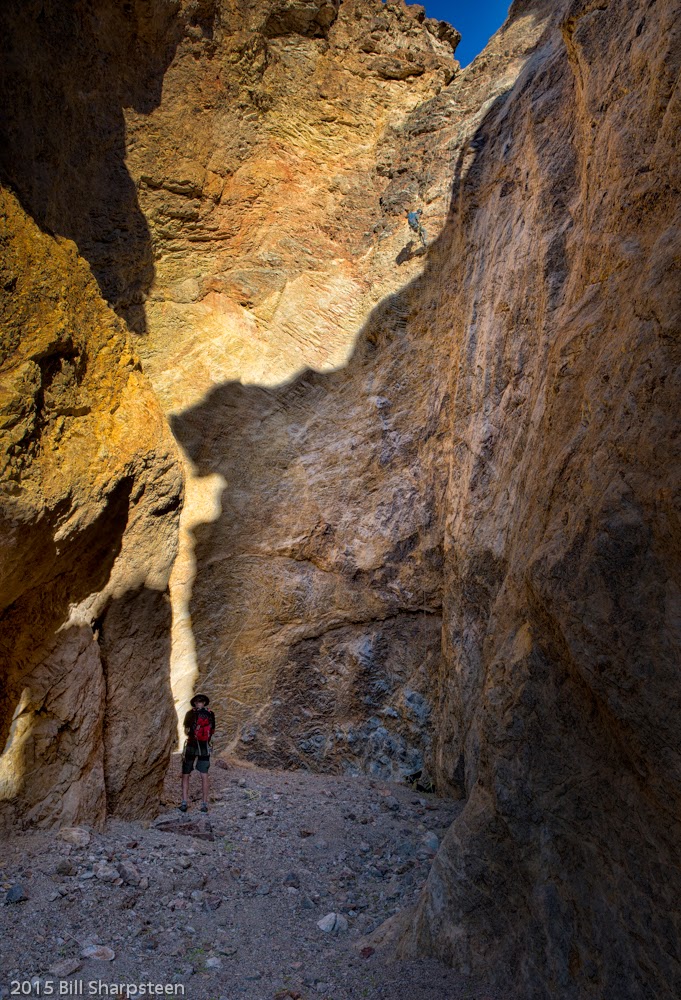
Nearly invisible from a short distance, Fall Canyon's entrance takes you into a cathedral of rock.
The lower section of Fall Canyon.
Fall Canyon narrows with views to the Grapevine Mountains above.
Yours truly winding through the upper Fall Canyon slot section.

Barrel cactus growing above the upper section of Fall Canyon.

The polished walls of upper Fall Canyon.

Just past this boulder the upper Fall Canyon narrows takes a quick left turn into another chamber.